

Introduction
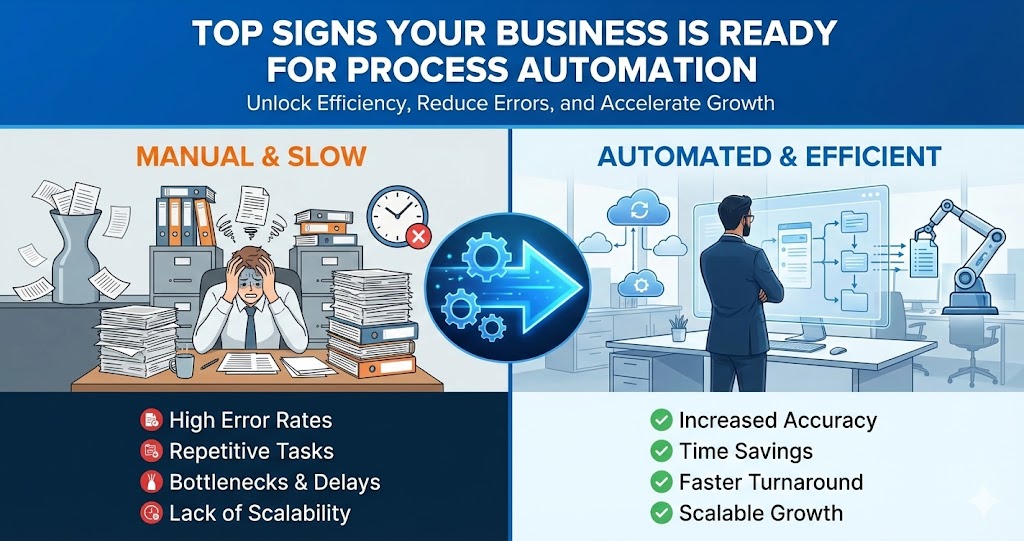
Not every business needs automation immediately. But at some point, manual processes stop being manageable and start showing growth. The challenge is that this shift doesn’t happen all at once. It shows up in small frustrations, repeated tasks, delayed approvals, inconsistent data, or founders spending too much time on routine operations. Recognizing business process automation readiness early can prevent operational stress later. At AMATEC, we help businesses assess whether they’re truly ready for automation and what readiness actually means.
If you recognise several of the signs below, it may be time to move on from “coping” to designing structured automation.
Your Team Repeats the Same Tasks Every Day
If your team is:
- Manually copying data between systems
- Sending the same follow-up emails
- Updating spreadsheets with information that already exists elsewhere
- Chasing approvals that follow the same pattern
You’re likely ready for automation. Repetitive work is the clearest indicator of business process automation readiness. AMATEC often begins by identifying exactly where this repetition consumes time and designing workflows that remove it.
Errors are Increasing as Volume Grows
Mistakes happen. But when errors increase with growth, incorrect data entries, missed updates, and billing mismatches, it’s usually a process issue, not a people issue. Manual processes don’t scale cleanly. Automation introduces consistency where volume would otherwise create risk. AMATEC works with growing teams to stabilize these processes before small mistakes become expensive ones.
Founders or Managers Are Stuck in Operational Loops
One of the strongest signs of automation readiness is leadership involvement in routine work.
If founders are:
- Approving standard tasks
- Reviewing repetitive reports
- Acting as the connection point between systems
The business is likely relying too heavily on manual coordination.
Automation should reduce dependency on individuals. AMATEC helps design systems where workflows move forward automatically within defined rules.
Reporting Takes Longer Than It Should
When reporting requires pulling data from multiple tools, cleaning it manually, and double-checking numbers, that’s a sign the underlying systems aren’t connected properly. Business process automation readiness often becomes obvious during month-end reporting or internal reviews. AMATEC frequently helps businesses automate reporting workflows so visibility improves while effort decreases.
Different Teams Follow Slightly Different Processes
As businesses grow, teams often create their own variations of the same process. Sales might handle data differently from operations. Finance may maintain separate records. These inconsistencies make scaling harder. Automation forces clarity. Before workflows are built, processes must be defined. This is why AMATEC combines readiness assessment with a structured automation strategy.
You’re Hiring to Manage Manual Work
Hiring to handle repetitive administrative tasks is often a temporary fix. If new roles are being created mainly to:
- Enter data
- Transfer information
- Coordinate between systems
- Manually track updates
It’s likely time to evaluate automation instead. AMATEC helps organisations identify which responsibilities should be automated and which should remain human-led.
You Don’t Fully Trust Your Current Automation
Sometimes automation already exists, but no one feels confident relying on it. This could mean:
- Workflows fail silently
- Ownership is unclear
- Logic is difficult to modify
- Teams double-check automated outputs manually
In these cases, readiness doesn’t mean “start automation”, it means “fix automation properly.” AMATEC often begins with a readiness consultation to assess what’s already in place and what needs restructuring.
What Business Process Automation Readiness Really Means
Readiness doesn’t mean automating everything. It means:
- Processes are consistent enough to define
- Growth is creating operational pressure
- Teams want reliability and visibility
- Leadership is ready to invest strategically
Automation is most effective when it’s introduced intentionally — not in reaction
Not Sure If You’re Ready?
If you recognized several of the signs above, your business may be ready for structured automation.
AMATEC offers readiness consultations to help decision-makers:
- Assess current processes
- Identify realistic automation opportunities
- Avoid premature or over-complicated solutions
- Build a roadmap aligned with growth
👉 Book a readiness consultation with AMATEC to evaluate your business process automation needs.
Conclusion
Process automation should reduce friction, not create it. Recognising the right time to invest is the first step toward doing it properly.
If your business is growing, experiencing operational strain, or relying too heavily on manual coordination, automation may not just be an improvement; it may be necessary.
AMATEC helps businesses move from reactive fixes to structured automation that supports long-term growth.
👉 Book your automation readiness consultation with AMATEC today.
