

Introduction
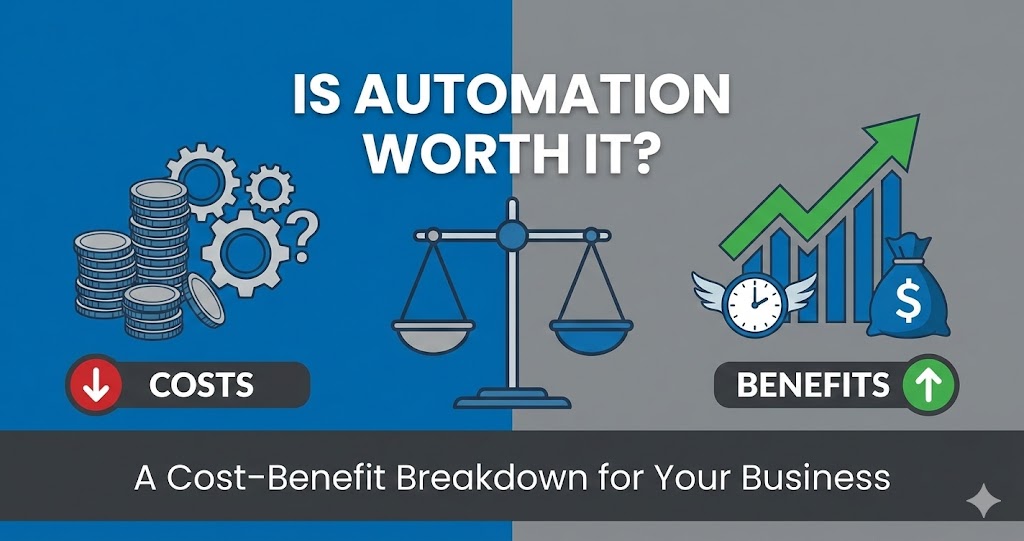
Automation is often presented as an obvious improvement. Save time. Reduce errors. Increase efficiency. But for many business leaders, the real question isn’t whether automation sounds good. It’s whether it’s actually worth the investment. Software costs money. Consulting costs money. Internal time costs money.
Before committing, decision-makers want clarity. What’s the return? When does automation pay back? What risks are reduced? This is where a structured automation ROI analysis becomes essential. At AMATEC, we work with serious buyers who want to evaluate automation through logic, not hype.
Understanding the Real Cost of Manual Processes
Many businesses underestimate the true cost of staying manual.
Manual processes rarely appear as a single line item. Instead, they show up as:
- Staff time spent on repetitive admin
- Delays between departments
- Errors that require correction
- Missed opportunities due to slow response
- Leadership time absorbed in operational tasks
When AMATEC conducts an automation ROI analysis, we often find that the cost of inefficiency is already higher than expected.
What Automation Actually Costs
Automation investment typically includes:
- Platform subscriptions
- Implementation or consulting fees
- Internal coordination time
- Ongoing monitoring and maintenance
The key question is not whether these costs exist; they do.
The real question is whether automation reduces larger, hidden costs elsewhere.
This is where a structured evaluation matters.
Calculating Automation ROI the Practical Way
At AMATEC, automation ROI analysis focuses on three measurable areas:
1. Time Recovery
How many hours per week are currently spent on repetitive work?
What is the cost of that time?
If automation removes 20–30 hours of manual work per week, the financial impact becomes measurable quickly.
2. Error Reduction
What is the cost of mistakes?
- Incorrect invoices
- Missed follow-ups
- Data inconsistencies
- Compliance risks
Automation introduces consistency. Reduced errors often translate directly into reduced cost.
3. Scalability Without Headcount
One of the strongest ROI drivers is scale.
If growth requires hiring additional staff purely to manage admin tasks, automation may offset those costs.
AMATEC frequently works with businesses that realise automation investment is lower than the cost of one additional full-time hire.
When Automation Is Probably Not Worth It
Not every business needs automation immediately.
Automation may not deliver a strong ROI when:
- Processes change daily and lack stability
- Volume is low
- Growth is unpredictable
- Leadership is not ready to commit to process clarity
AMATEC advises against automation when the foundation isn’t ready. Honest assessment protects long-term ROI.
When Automation ROI Becomes Clear
Automation typically makes financial sense when:
- Work volume is consistent
- Manual processes are repetitive
- Errors create measurable cost
- Teams are stretched operationally
- Growth is expected
At this stage, automation is not just about efficiency. It becomes a strategic investment.
Why Automation ROI Analysis Should Come Before Implementation
Jumping into automation without structured ROI analysis often leads to disappointment.
AMATEC positions automation ROI analysis as a first step. This allows decision-makers to:
- Quantify potential time savings
- Identify high-impact workflows
- Estimate realistic payback periods
- Avoid over-investment
Serious buyers benefit from clarity before committing to implementation.
How AMATEC Helps You Evaluate Automation Investment
AMATEC works with organisations that want evidence before action.
Our automation ROI analysis typically includes:
- Process review and mapping
- Time-cost evaluation
- Risk assessment
- Scalability modelling
- Prioritised automation roadmap
This ensures automation is introduced where it creates measurable value, not just technical change.
Considering Automation? Start with ROI
If you’re evaluating whether automation is worth it, the right first step is not implementation, it’s analysis.
AMATEC offers structured automation ROI consultations to help businesses determine:
- Where automation delivers financial impact
- What investment level makes sense
- How quickly automation pays back
👉 Book a consultation with AMATEC to conduct your automation ROI analysis.
Conclusion
Automation is not automatically worth it. But for many growing businesses, the cost of staying manual is higher than they realize.
A structured automation ROI analysis brings clarity. It separates hype from measurable value.
AMATEC helps decision-makers evaluate automation logically, ensuring investment decisions are backed by data, not assumptions.
👉 Book your automation ROI consultation with AMATEC and make an informed decision.
